Linked IN

Ocean Law Bulletins

Commercial Use of Marine Areas (CUMA) Bill 2025: A landmark piece of legislation and the importance of a consultative implementation process

Dec 4, 2025 / by James Sloan posted in UNCLOS, Sovereignty, Fiji Oceans, administrative law, Fiji's Constitution, Investing in Fiji, Hotel and Tourism Fiji, Nearshore Fiji fisheries, fisheries law, traditional rights, Blue Economy, Fiji National Ocean Policy, Fiji Blue Economy, Fiji blue carbon, Surfing Act Fiji, Fiji property rights, Surfing Act, iqoliqoli

The Commercial Use of Marine Areas (CUMA) Bill 2025 is a pioneering piece of legislation that has the purpose of transferring proprietary ownership of commercial nearshore marine areas to relevant iTaukei landowning groups following a process set out in the legislation. CUMA therefore intends to change the State-centric ownership model of nearshore marine areas. While this initiative is lauded for its intent to promote indigenous economic rights the transfer of tenure in marine or nearshore areas will have far reaching consequences. For example, CUMA will require the mandatory renegotiation of existing leases that has the risk of creating economic uncertainty within Fiji’s tourism-dependent economy.

Further legal questions will arise regarding the constitutional right to property and fair compensation for any loss of property rights that could arise as CUMA is implemented. In addition, the Bill repeals the Regulation of Surfing Areas Act 2010, which ensured free access to Fiji’s world-class surf breaks. The commercial arrangements that will now be put in place for surfing areas will require careful consultation to balance the resource owners' right to compensation with the interests of the surf tourism industry and the public.

To manage these complexities and mitigate the risk of unintended consequences the implementation of CUMA requires a careful, transparent and collaborative approach. This includes identifying any adversely affected legal rights and conducting a rigorous, independent economic impact assessment and engaging in extended, focused consultation with all affected stakeholders—from tourism operators and developers to the surfing community— to ensure a smooth, lawful, and economically viable transition in the interests of indigenous rights, Fiji’s economy and the existing rights of all stakeholders.


Read More

The management of Fiji’s nearshore fisheries will benefit from a good decision making process leading to Fisheries Regulations

Mar 21, 2018 / by Emily Samuela and James Sloan posted in Beche de mer, Fiji fisheries, Fisheries Act, Commercial fishing, Marine Conservation, Traditional fishing rights, Inshore fisheries, administrative law, Fiji's Constitution, Environmental governance, Nearshore Fiji fisheries, Fiji Fisheries decision making, Fiji Fisheries Regulations

Healthy stocks of fish and other aquatic animals in Fiji’s nearshore waters are vital for the nation’s well-being and food security needs. Healthy stocks are also a priority for the Ministry of Fisheries and Honourable Minister for Fisheries, Semi Koroilavesau who speaking in Parliament recently explained that the Ministry would refocus its efforts on nearshore and coastal fisheries with the aim of balancing development with national and local needs.

The good regulation of fishing activity in nearshore waters is part of the answer to improve fish stocks.

In this legal bulletin we consider the current nearshore fisheries regulatory regime and discuss how the use of Fisheries Regulations could improve fisheries management. The use of regulatory powers is an exercise of public law and as such Fiji’s common law system requires a careful and consultative decision-making process.

Read More

Fiji's Minister for Fisheries has created two new Marine Reserves with Regulations made under powers conferred by section 9 of the Fisheries Act, 1941

Jan 30, 2018 / by James Sloan posted in Marine Protected Areas, Fiji fisheries, Fisheries Act, Traditional fishing rights, Inshore fisheries, administrative law, Environmental decision making, Fiji law

On, Friday, 19th January 2018 by Legal Notices No. 3 and No. 4 the Honourable Minister for Fisheries exercised his powers pursuant to section 9 of the Fisheries Act, Cap 158 (Fisheries Act) to create two new marine reserves in inshore areas within Fiji’s fisheries waters.

The creation of the marine reserves has been by way of Regulations that are cited as:

Fisheries (Kiuva Marine Reserve) Regulations 2018
Fisheries (Naiqoro Passage Spawning Aggregation Marine Reserve) Regulations 2018.

In this legal bulletin we set out the powers that section 9 of the Fisheries Act provides to the Minister for Fisheries to create and declare marine reserves via Regulations. We also expand on the effect of these new Regulations that have been brought into force by being published (gazetted) in Fiji’s Government Gazette.

Read More

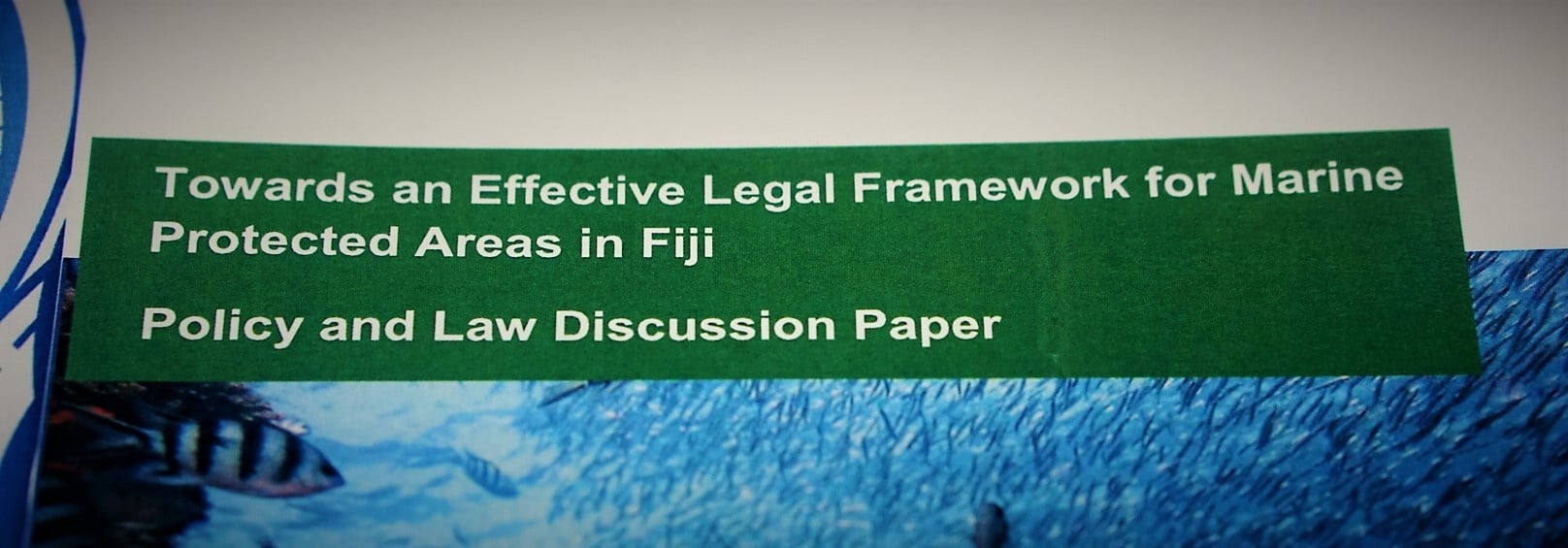
The legal framework for effective Marine Protected Areas in Fiji - the Fiji Environmental Law Association's latest publication

Sep 14, 2017 / by James Sloan posted in Marine Protected Areas, Fiji fisheries, Fisheries Act, Fiji Oceans, fisheries management, administrative law

The Fiji government has made a bold commitment to designate marine protected areas (MPAs) across 30% of its ocean spaces.

Given the well documented threats to all oceans and their resources it is a natural response to create protected areas that restrict the use of certain areas of ocean. The aims for greater protection may be varied and include to protect areas or species of special scientific interest, to preserve bio-diversity, for fisheries management reasons including for food security or to promote resilience to natural disasters and counter the effects of climate change. However, MPAs are designed to restrict the way a designated area of ocean is used, and because of this the designation of a MPA may alter, restrict, reduce, or remove pre-existing rights and commercial interests to use the marine area subject to the designation. As such the creation of MPAs may raise ethical questions and will definitely raise legal questions particularly in the area of administrative law. Last February we published this bulletin that looked at the designation of MPAs from an administrative law perspective.

In September 2017, the Fiji Environmental Law Association (FELA) together with EDO NSW and the University of the South Pacific (USP) has added to the MPA discussion through a study that considers the existing legal framework in Fiji for the creation of MPAs. This study is entitled “Towards an Effective Legal Framework for Marine Protected Areas In Fiji - a Policy and Law Discussion Paper” (ISBN 975-982-01-0965-0), and available now from the USP bookshop.

Read More

Subscribe to Email Updates

Recent Posts

Posts by Topic

see all